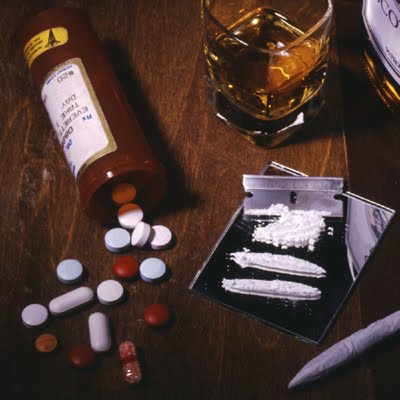
If we look at other aspects of prohibition we see the generation of significant violence and harms.The MDA makes all consumers criminals. A third of the population admits drug use in the British Crime Survey. (Hoare and Flately 2008:5) Of course all these people are not subjected to criminal justice intervention, the system simply couldn’t cope, but all of them are liable to arrest, a criminal record and imprisonment. Events that could have a dramatic bearing on their lives. Jobs and homes are lost regularly by consumers who come into contact with the criminal justice system.The impact of this is not spread evenly across the community. I have not been able to calculate the racial profile in the UK but figure 5 below shows how this process plays out for African-Americans.
Figure 5 (Source Jones et al 2005:13)
The war in drugs was launched by Richard Nixon. His Chief of Staff recorded in his diary, that Nixon had ‘emphasized that you have to face the fact that the whole problem is really the blacks. The key is to devise a system that recognises this while not appearing to.’ Halderman 1994:53) The war on drugs has proved to be such a system.
The inequality generated by the selective enforcement of drug prohibition in Britain urgently requires detailed research. The Home Office was required to carry out an Equality Impact Assessment on their new drugs strategy in 2007. The first section of the assessment, titled Preliminary Screening, includes the question: ‘Could the aims of the policy be in conflict with equal opportunity, elimination of discrimination, promotion of good relations?‘ (Home Office 2008) To which the Home Office replied ‘NO’. This and the document in general demonstrate contempt for equality, which is reduced to a form filling exercise cynically ignoring a considerable body of evidence of inequality generated by the war on drugs.
The illegality of substances does not just impact on crime by criminalising their consumers. It has much wider impacts both within the UK and internationally and generates dramatic levels of harm. Central to this generation of crime and violence is prohibition, which in terms of policy, places the entire market, production, distribution, wholesale and retail, into the hands of organised crime. The illegal drug market is a state sponsored, tax free monopoly for criminals. The consequences of this are dramatic; however because of limited space I will restrict myself to a few examples
1.Generation of acquisitive crime
Figure 6 below shows the cost of drug use for a heavy user in 2003. Having a Cocaine or heroin habit is expensive, raising £300, £400 or even £500 a week is impossible for most people through legal means. They resort to crime. The Strategy Unit estimated that 56% of the total number of crimes; some thirty six million crimes, are ‘drug-motivated crimes’ committed by drug users. (SU Drugs Project 2003:22) This is illustrated in Figure 7, again copied from the Strategy unit report to the cabinet.
Figure 6 (Source: SU Drugs Project 2003:12)
Figure 7 (Source: SU Drugs Project 2003:22)
Home Office Research has estimated that drug-motivated crime in total costs victims just under ten billion pounds per year and the economic costs to the community of the average ‘problematic drug user’ is in excess of £44,000. (Gordon et al 2006:44 & 41) In this market, unregulated prices emerge which lead to increased crime. The government’s own analysis finds that over half of all crime and victimisation are linked to behaviours generated by the economics of this market - which the government chooses not to regulate.
2. Prostitution of drug users
For many women and girls and a few men and boys, fundraising is achieved not through acquisitive crime but by prostituting themselves. Research carried out for the Home Office has shown that the drug and sex markets are intrinsically linked. (Hunter and May 2004) The same factors detailed above for acquisitive crime drive adults and children into prostitution. The Home Office’s Equality Impact Assessment makes no mention of the contribution of drugs policy in generating supply within prostitution nor does it acknowledge the gendered status of prostitution. (Home Office 2008)
3. Generation of Violence
In a review of economists’ contribution to the study of crime, Dills et al (2008:3) concluded that ‘economists know little about the empirically relevant determinants of crime.’ Applying various hypotheses on subjects as varied as arrest rates, capital punishment, gun laws and abortion rates, to an examination of aggregate data over long time periods and across countries exposed the various theories as wanting. However, they did ‘find one theory that is consistent with the aggregate time series and cross-country data on crime: the view that enforcement of drug prohibition encourages violent dispute resolution.’ (Ibid:22) Drug markets operate outside the law and have no recourse to legal procedure to resolve disputes. Drug dealers use violence to collect debts, they use violence to resolve disputes between themselves and they use violence to resist law enforcement efforts. Prohibition makes violence a cost effective business strategy. It introduces guns and knives on to our streets as routine business tools. Sometimes the state responds with violence. China celebrated UN world anti-drugs day in 2002 with the mass execution of 64 drug offenders. (Rolles et al 2006) Thailand’s security services murdered almost two and half thousand alleged drug dealers in just three months, in pursuit of the war on drugs. (Human Rights Watch 2004) Even lawful criminal justice responses generate perverse outcomes. As Sanho Tree has argued, law enforcement operates as a Darwinian natural selector removing less ruthless and less violent market participants. (Tree 2007) Over time law enforcement has driven out the non violent hippys like Howard Marks and replaced them with brutal, callous and vicious gangsters. (Marks 1996, Glenny 2008) The violence of the market raises prices; Caulkins & Reuter (1998) estimate that 33 per cent of the retail price of cocaine is paid to compensate dealers for their risk of death or injury. This in turn increases the fundraising requirements of problematic users, thus increasing crime and its associated victimisation.
4. Destabilisation of producer and transit countries
As well as generating considerable levels of violence in consumer countries like the UK the drug business has a far more dramatic impact on producer and transit nations. In Latin America, the Caribbean, Africa and Asia nations have been destabilised as a direct consequence of the so called war on drugs. Last year Michael Schulenburg, the UN Mission Chief in Sierra Leone observed ‘that the exposure to the international drug trade is the single biggest risk affecting the future of Sierra Leone’. (Reuters 2008) Guinea-Bissau has seen both its President and army chief murdered this year, killings directly linked to the country’s status as a transit country for the cocaine trade. (McGreal 2009) Internationally the war on drugs has subjected many poor nations to wave after wave of violence.
Ecstasy can help the victims of post-traumatic stress overcome their demons, research has shown. In tests, the illegal dance drug had a dramatic effect on previously untreatable patients who suffered post-traumatic stress disorder (PTSD).
On April 8th I took part in a public debate at The Watershed in Bristol about how we respond to drugs. The debate was recorded and is now available on the web as the August Philosophy Monthly Podcast.
On the 17th March Daily Telegraph hack Heidi Blake wrote about Mephedrone and the dangers it presented; which she claimed, following the Telegraph editorial line required an immediate ban. Her article went under the headline Mephedrone: the truth about 'miaow miaow' In the article Blake claimed that:
In November Gabrielle Price, 14, of Worthing West Sussex, died after allegedly taking the drug.
It has now been established that death resulted from cardiac arrest following broncho-pneumonia which resulted from a streptococcal A infection.
As it was clear that Gabrielle's death was from natural causes, and had nothing whatsoever to do with Mephedrone or any other drug, there was no need for a full inquest.
I therefore saw a certain irony when my attention was drawn to th screen shot below posted on the web by badjournalism. It shows a search for stories on mephedrone on the Daily Telegraph website. As well as these stories the viewer is also directed to a number of suppliers of the drug. These are paid adverts provided by google. So although the Telegraph demands an immediate ban in the meantime they are happy to earn their referral fees from the pushers.
As you can see Heidi Blake story is shown up by the search which looks like it was done on the following day, March 18th.
If you are near Bristol and fancy hearing me speak in person I will be taking part in this event next week
What: Addiction: should we penalise or treat? A public debate
When: Thursday 8 April 2010, 18:30-20:00
Where: Watershed, 1 Canon's Road, Harbourside, Bristol, BS1 5TX
Addiction: should we penalise or treat? is the topical subject of a free public debate organised by University of the West of England philosopher, Dr Havi Carel. The event will take place on Thursday 8 April 2010 from 18:30 to 20:00 at the Watershed in Bristol.
The public debate is one of the events funded by the Arts and Humanities Research Council (AHRC) as part of the three year research project - The Concepts of Health, Illness and Disease. Project leader, Dr Carel explains, “This research project brings together researchers from diverse disciplines to develop an understanding of health, illness and disease. This is crucial to society as how we define illness can have ethical, social and economic consequences. Addiction is an emotive topic that clearly highlights these issues. One example is smoking - should the NHS pay for the treatment of nicotine addiction or are smokers just weak-willed? By drawing on the expertise of a multidisciplinary team of speakers, the audience will hear multiple approaches to the issue before being invited to join in the debate.”
The speakers are:
Dr Nick Airey, an NHS psychiatrist specialising in addiction
Dr Piers Benn, Medical ethics
John Moore, Criminology, UWE
Dr Giles Pearson, Philosophy, University of Bristol
Dr Jonathan Webber, Philosophy, Cardiff University
Chair: Dr Julian Baggini, Editor of The Philosopher's Magazine
This event is free of charge to the public and a large audience is expected. This event is free of charge but booking is essential, to book a place e-mail Dr Havi Carel - Havi.Carel@uwe.ac.uk
Dr Carel concludes, “The event has attracted interest from clinicians, drug and addiction practitioners, and service users. It promises to be a lively debate and is a chance for the public to contribute to our research. We are planning to record the debate as a podcast on the project website, as well as on the AHRC website and The Philosopher's Magazine website.”
Part of the deal is if they find something they dob your child up to the police. Thus ensuring not only that they have completely violated their child's trust but that they have also severely damaged their future life by getting them a criminal record.
Regular readers of this blog will be aware of all the fuss surrounding Home secretary Alan Johnson's decision to sack David Nutt as Chair of the Advisory Council on the Misuse of Drugs for telling the truth. In classic New Labour style a nasty attempt was made to get at Nutt through press stories about his children. [Interestingly the evening that Nutt made his speech I ended up chatting to his wife about how alcohol represents the most dangerous drug for young people - our kids are roughly the same ages.]
Despite this silence well done Stephen - few take on the evil Sun and win.
Lest we forget
This picture relates to the call to boycott the Sun over its scummy reporting of the Hillsborough tradegy when 96 Liverpool fans were killed. For background read here
So what do we do about currently illegal drugs? Whenever I critique the failed war on drugs this is the question I am asked. Good question and it normally takes me 10 to 15 minutes to set out what a regulated market might look like. Fortunately the Hungarian Civil Liberties Union have produced this wonderful short film answering the question.
The report featured in the film 'After the War on Drugs: Blueprint for Regulation' can be dowloaded for free from Transform Drug Policy Foundation by clicking here
Declaration of Interest - I worked for Transform during 2007 and 2008.
The Scottish Prison Service has announced they will be closing Noranside prison over the Christmas period. Unfortunately the closure is only for a week but it is a start. Hopefully in the not to distant future we will be closing prisons for good and finding more civilised ways for resolving conflicts and avoiding harm.
Boy George has had his attempt to appear in Celebrity Big Brother blocked by his Probation Officer on the basis that his appearance would undermine confidence in the judicial service if he wins. This rather silly decision is in line with emerging culture in probation that is so risk averse that the standard answer to all requests from those subject to probation supervision is ‘the computer says no’. The increasingly reactionary Harry Fletcher of NAPO has told the Sun that the problem is that if George was in the BB house he couldn’t report to his local probation office regularly. The poor Probation staff would then clearly have no idea where he is! Good luck to George on getting this overturned.
Pablo the Drug Mule Dog now has his own page on facebook. From reading the comments not a great success.
Whilst the Home Office continue to celebrate their failed drug strategy with a party to celebrate the one millionth piss test (it was negative) a Judge in Canada has let slip that the Emperor has no clothes. Justice Elliot Allen was asked by a federal prosecutor to jail a man for growing weed. He responded "What's your basis for saying that?” before he pointed out: " People have been going to jail for drug offences for – for a couple of generations now and the drug – the drug plague is worse than it ever was." Why should he continue doing something that clearly did not work? "Isn't that a form of insanity?" he asked. The Appeal Court have given Justice Allen a slap and reminded him that his duty is to enforce the law even if it is insane, doesn’t work, increases drug use and helps funds organised crime.
Meanwhile the Daily Mail warns that 'Heroin and crack dealers are enrolling at British universities to secure thousands of pounds of cheap loans and low priced accommodation’. The evidence for this is underwhelming. They point out that students are entitled to up to £4,950 a year and 72 per cent take up their entitlement to loans. Police operations, the Daily Mail inform us, have revealed three cases where suspected drug dealers were students. Sounds like a good reason to put up university fees, jail Sociology Lecturers and abolish student financial support. Well we must protect our young.
Lastly bad news for the United States economy. After decades of drug dealers helping fund the American Government’s deficit by holding their billions of dollars of drug war profits in $100 notes organised crime is modernising and in an attempt to cut down on storage they are converting their assets into E500 notes. Any bets on the Americans responding by issuing a $1,000 dollar note?
Drugs and crime chief says $352bn in criminal proceeds was effectively laundered by financial institutions
Drugs money worth billions of dollars kept the financial system afloat at the height of the global crisis, the United Nations' drugs and crime tsar has told the Observer.
Antonio Maria Costa, head of the UN Office on Drugs and Crime, said he has seen evidence that the proceeds of organised crime were "the only liquid investment capital" available to some banks on the brink of collapse last year. He said that a majority of the $352bn (£216bn) of drugs profits was absorbed into the economic system as a result.
This will raise questions about crime's influence on the economic system at times of crisis. It will also prompt further examination of the banking sector as world leaders, including Barack Obama and Gordon Brown, call for new International Monetary Fund regulations. Speaking from his office in Vienna, Costa said evidence that illegal money was being absorbed into the financial system was first drawn to his attention by intelligence agencies and prosecutors around 18 months ago. "In many instances, the money from drugs was the only liquid investment capital. In the second half of 2008, liquidity was the banking system's main problem and hence liquid capital became an important factor," he said.
Some of the evidence put before his office indicated that gang money was used to save some banks from collapse when lending seized up, he said.
"Inter-bank loans were funded by money that originated from the drugs trade and other illegal activities... There were signs that some banks were rescued that way." Costa declined to identify countries or banks that may have received any drugs money, saying that would be inappropriate because his office is supposed to address the problem, not apportion blame. But he said the money is now a part of the official system and had been effectively laundered.
"That was the moment [last year] when the system was basically paralysed because of the unwillingness of banks to lend money to one another. The progressive liquidisation to the system and the progressive improvement by some banks of their share values [has meant that] the problem [of illegal money] has become much less serious than it was," he said.
The IMF estimated that large US and European banks lost more than $1tn on toxic assets and from bad loans from January 2007 to September 2009 and more than 200 mortgage lenders went bankrupt. Many major institutions either failed, were acquired under duress, or were subject to government takeover.
Gangs are now believed to make most of their profits from the drugs trade and are estimated to be worth £352bn, the UN says. They have traditionally kept proceeds in cash or moved it offshore to hide it from the authorities. It is understood that evidence that drug money has flowed into banks came from officials in Britain, Switzerland, Italy and the US.
British bankers would want to see any evidence that Costa has to back his claims. A British Bankers' Association spokesman said: "We have not been party to any regulatory dialogue that would support a theory of this kind. There was clearly a lack of liquidity in the system and to a large degree this was filled by the intervention of central banks."
But don't worry in Britain the war on drugs is moving forward by a brave decision of a committee of MPs to go clubbing. This will, they believe allow them to understand cocaine. They are not thought to be considering testing the substance. They intend to stay safe and stick to alcohol.
There is growing recognition globally that the prohibition of drugs is a counterproductive failure. However, a major barrier to drug law reform has been fear of the unknown – what could a post-prohibition regime look like? In answering that question, Blueprint demonstrates that legally regulating drugs is not a step into the unknown, but a tried and tested approach to control drug production, supply and use.
The book is available as a freedown load here (7.7mb)
David is a scientist not a politician and much of his work has been about identifying the harms associated with various drugs and other activities. His research shows that most illegal drugs are less harmful than legal drugs and other activities. The fact that horse riding is more dangerous than taking ecstasy and smoking cannabis is far less likely to kill you than wine or beer is an inconvenient truth for a government that whilst supporting the alcohol industry promotes the criminalisation of less harmful drugs on the basis of risk. The chart below produced by Nutt compares the harmfulness of legal and illegal drugs:
This shows clearly that the claim that drug classification is anything to with harm is nonsense.
Despite having demonstrated the nonsense of drug policy Nutt was appointed as Chair of the Advisory Committee on the Misuse of Drugs (ACMD) effectively making the Government's chief advisor on drug policy. Not surprisingly Nutt tried to advise the Government to move towards an evidence based policy and to sort out the mess of the classification system. This was too much for Home Secretary Alan Johnson who following the publication of the Eve Saville Lecture last week sacked Nutt.
Much though I respect David Nutt I thought he was wrong as the classification system needs abolishing not reforming. This case has been made powerfully by Steve Rolles in an article The ABC of UK drug classification - not fit for purpose (pages 7-9). Essentially classification links criminal sanctions to 'harmfulness'. This presumes that criminal justice is the most appropriate method for managing drugs potential harm. This approach has clearly failed with drug use increasing, availability widening, and price falling since it was introduced. It has also seen incentives on producers to produce stronger products and dealers to mix all sort of (often dangerous) rubbish with the product.
I suspect that although Nutt was an irritant to Government whilst he was an advisor, insisting on telling them truths they really didn't want to hear he will be a more substantial critic now he has been sacked. Freed from the ACMD and its role in the classification system he will now be able to look at wider drug policy and use his expertise to critique drug policy in far more detail. His sacking is likely to prove a massive mistake for government.
FURTHER UPDATE there is a petition which can be signed up to on the Prime Minister's web site - you can sign it here
It says:
We the undersigned petition the Prime Minister to Re-instate Professor David Nutt On 30 October 2009 the Home Secretary sacked the Chair of the Advisory Council on the Misuse of Drugs. Professor Nutt has expressed politically unpopular opinions such as -
Alcohol ranks as the fifth most harmful drug after heroin, cocaine, barbiturates and methadone. Tobacco is ranked ninth"
and
Cannabis, LSD and ecstasy, while harmful, are ranked lower at 11, 14 and 18 respectively."
Drug policy should be based on science not hysteria. Scientists expressing their honestly held expert opinions should not find themselves in fear of losing their jobs.
Stabby Joe and Gassing Rapists
-
There are two truisms that should guide your understanding of anything
related to crime and punishment- If it looks too simple, then it is; and
the law o...
STEPHEN SINCLAIR WASHINGTON DOC
-
*ARTICLE BY JIM BRUNNER SEATTLE TIMES*
Washington prisons chief Stephen Sinclair was forced out of his job by Gov.
Inslee, records show By Jim Brunner...
Films of the Year 2019
-
For the seventeenth consecutive year, this is my annual list of films I've
watched over the last 12 months. As ever, this means actual visits to the
cinem...
Increase Your Productivity as a Working Parent
-
This is a sample intro paragraph and can be used to introduce readers to
your article. This is an example of a WordPress post, you could edit this
to put i...
5 of the best personal finance books out there
-
My name is Ema and I’m a self-confessed book-a-holic. Phew! It feels good
to get that off my chest. I absolutely love reading and more often than
not, read...
This blog has moved!
-
This blog now updates at http://www.penny-red.com/.
It's been a fun four years at blogspot, but the new site is much shinier.
Update your bookmarks! :)
STOKES CROFT: FREE SHOP
-
Having faced an eviction and then having sitex plastered all over the
front of it, the communities freeshop has been given a revamp! The ethos of
the free...
Moving home
-
Almost three years ago I welcomed readers to this space with these words:
"What the world really needs is another blog. With only 175,000 created
every day...
Thought of the Day
-
" There was a proposition in a township there to discontinue public schools
because they were too expensive. An old farmer spoke up and said if they
stoppe...
Home Page
-
*OBJECT challenges ‘sex object culture’ – the normalising of the porn and
sex industry through lap dancing clubs, Page 3 and sexist ads.* OBJECT is
an aw...